History
The Boston Tea Party: How a Tax Protest Changed History
On the night of December 16, 1773, a group of American colonists carried out one of the most famous acts of political protest in world history. By dumping hundreds of chests of British tea into Boston Harbor, they made a clear and defiant statement: taxation without consent would not be tolerated. What became known as the Boston Tea Party was not a spontaneous riot, but a carefully organized act of civil resistance—one that helped push the American colonies toward revolution.
Britain’s Growing Control Over the Colonies
After the French and Indian War (1754–1763), Great Britain faced massive debt. Parliament believed the American colonies should help pay for their defense and administration. Colonists, however, had no representatives in Parliament and argued that new taxes violated their rights as English subjects.
Throughout the 1760s, Parliament imposed a series of unpopular taxes, including the Stamp Act and the Townshend Acts. Colonial resistance—boycotts, protests, and organized political action—forced Parliament to repeal most of these measures. One tax remained: the tax on tea. It was deliberately kept as a symbol of Parliament’s authority over the colonies.
The Tea Act of 1773
In 1773, Parliament passed the Tea Act to rescue the struggling British East India Company, which was burdened with surplus tea and financial instability. The law allowed the company to sell tea directly to the American colonies, bypassing colonial merchants and offering tea at a lower price—even with the tax included.
To Parliament, this was a practical economic solution. To many colonists, it was a trap. Purchasing the tea would mean accepting Parliament’s right to tax them without representation. Cheap tea was irrelevant if it came at the cost of political submission.
Why Boston Became the Center of Resistance
Boston had long been a hub of colonial dissent. Patriot leaders such as Samuel Adams and the Sons of Liberty organized opposition to British policies through public meetings, pamphlets, and boycotts.
In late 1773, three ships carrying taxed tea arrived in Boston Harbor: the Dartmouth, the Eleanor, and the Beaver. Massachusetts Governor Thomas Hutchinson refused to allow the ships to leave without unloading the tea and collecting the tax. Under British law, the cargo would be seized if it remained unpaid for 20 days.
Thousands of colonists gathered at the Old South Meeting House to debate what to do. Repeated demands to return the tea to England were rejected. With the deadline looming, tensions reached a breaking point.
December 16, 1773: The Boston Tea Party
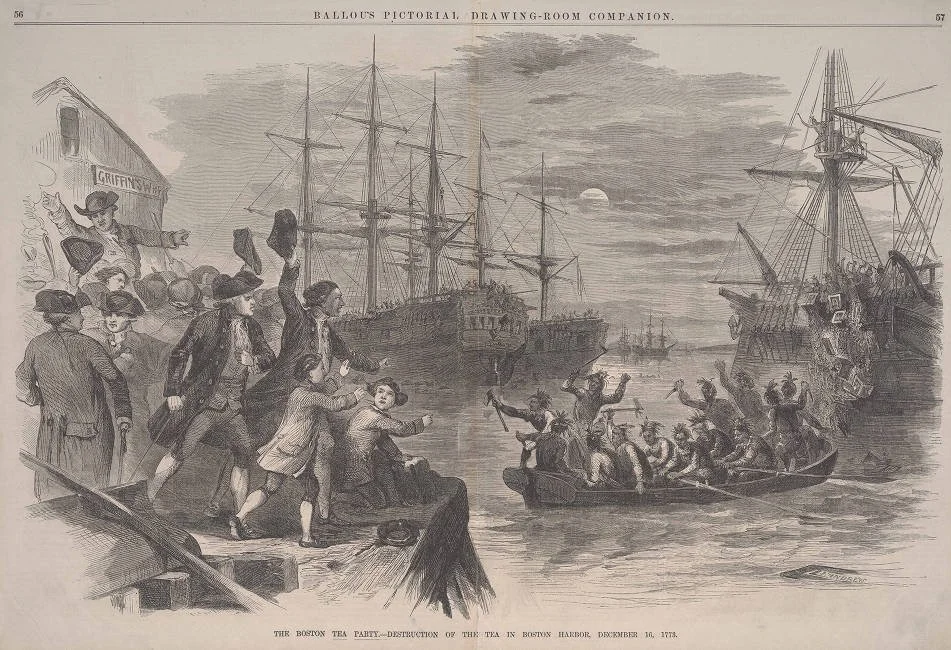
On the evening of December 16, following a final mass meeting, a group of approximately 60 to 120 colonists took action. Disguised as Mohawk Indians—a symbolic gesture representing American identity and providing anonymity—they marched to Griffin’s Wharf.
Over the course of several hours, the protesters boarded the three ships and dumped 342 chests of tea into Boston Harbor. The tea was worth roughly £10,000 at the time—millions of dollars today.
No one was injured. No other cargo was damaged. Broken locks were replaced. The protest was disciplined and deliberate. This was not chaos or mob violence. It was targeted property destruction intended to send a political message.
Britain’s Response: The Intolerable Acts
News of the Tea Party outraged British officials. In 1774, Parliament passed a series of punitive laws known in Britain as the Coercive Acts, and in the colonies as the Intolerable Acts. These measures included:
Closing Boston Harbor until the tea was paid for
Stripping Massachusetts of local self-government
Allowing British officials accused of crimes to be tried outside the colonies
Expanding the Quartering Act to house British troops
Rather than isolating Massachusetts, these acts united the colonies in opposition to British rule.
From Protest to Revolution
The Boston Tea Party marked a turning point. It demonstrated that colonial resistance had moved beyond petitions and boycotts to direct action. In response to Britain’s crackdown, colonial leaders convened the First Continental Congress in 1774 to coordinate resistance.
Less than two years later, armed conflict erupted at Lexington and Concord, launching the American Revolutionary War.
Why the Boston Tea Party Still Matters
The Boston Tea Party is remembered not simply as a protest over taxes, but as a powerful statement about consent, accountability, and legitimate government authority. It showed that when people believe the social contract has been broken, symbolic acts of resistance can reshape history.
More than 250 years later, the Boston Tea Party remains a lasting reminder that public trust is essential to governance—and that when trust collapses, resistance follows.